


What Is Coinsurance in Property Insurance? A Guide for Small Business Owners
For small business owners, coinsurance in commercial property insurance can be the difference between getting your full claim paid or facing a big out-of-pocket hit after a loss. If your property isn’t insured close enough to its actual value, your insurer may reduce your payout—even if the damage amount is well below your policy limit. This can delay repairs, replacements, or getting your business back on track.
What is coinsurance in commercial property insurance?
Coinsurance is a policy clause that requires you to insure your commercial property for at least a certain percentage of its total value—most often 80%, but sometimes 90% or 100%. This percentage is set to ensure you have adequate coverage.
For example, if your building is worth $1 million and your policy has an 80% coinsurance requirement, you need at least $800,000 in coverage to avoid penalties on a claim.
If you’re underinsured (below that percentage), your insurer applies a penalty when you file a claim, meaning you pay more out of pocket.
(Note: This differs from health insurance, where coinsurance is the percentage of medical costs you pay after meeting your deductible—e.g., you pay 20%, insurance pays 80%. In rare cases, “coinsurance” can also refer to multiple insurers sharing a risk, but in property insurance, it almost always means the clause described above.)
How does coinsurance work?
The coinsurance clause encourages full (or near-full) coverage so you’re properly protected in a disaster. If you meet the requirement, claims are paid normally (minus your deductible). If not, a penalty reduces your payout proportionally.
Example 1: Properly insured (meets coinsurance)
-
Building value: $1,000,000
-
Coinsurance requirement: 80% → Required coverage: $800,000
-
Your policy limit: $800,000
-
Deductible: $1,000
A fire causes $50,000 in damage.
You pay the $1,000 deductible.
Insurer pays the remaining $49,000—no penalty.
Example 2: Underinsured (penalty applies)
Same building value ($1,000,000) and coinsurance (80%), but you only bought $600,000 in coverage to save on premiums.
Fire causes $50,000 in damage.
Pre-penalty amount: $50,000 – $1,000 deductible = $49,000.
Penalty calculation: (Coverage carried ÷ Coverage required) × Pre-penalty amount
= ($600,000 ÷ $800,000) × $49,000 = 0.75 × $49,000 = $36,750 paid by insurer.
You end up paying the deductible ($1,000) + the penalty shortfall ($12,250) out of pocket—totaling $13,250 instead of just $1,000.
The standard coinsurance penalty formula is:
(Amount of insurance carried ÷ Amount of insurance required) × (Loss amount – Deductible) = Insurer payout
This leaves you responsible for the rest.
Coinsurance vs. copay vs. deductibles: What’s the difference?
These terms often get mixed up, but in small business/property insurance:
-
Coinsurance — A requirement to insure your property to a percentage (e.g., 80–90%) of its value; failing this triggers a claim penalty.
-
Deductible — The fixed amount you pay out of pocket before insurance covers anything on a claim.
-
Copay — A flat fee you pay for a specific service (common in health insurance, not property insurance).
-
Policy limits — The maximum the insurer will pay for a covered loss.
-
Premium — Your regular payment to keep the policy active.
In property claims: You first pay the deductible. Then, if underinsured, coinsurance reduces what the insurer pays on the remaining amount.
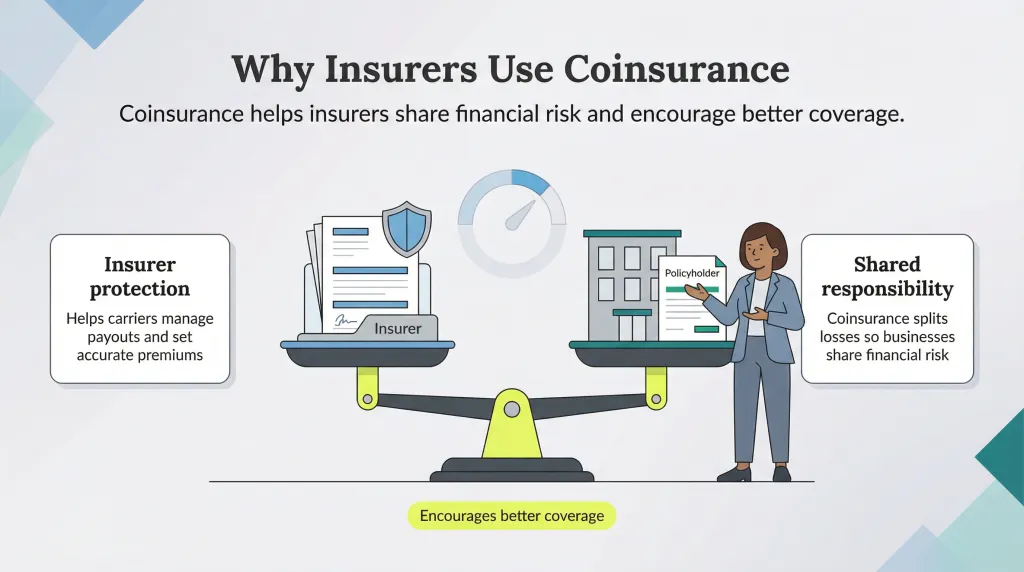
What’s the purpose of coinsurance?
Coinsurance isn’t just a “gotcha” from insurers—it’s a fair risk-sharing tool that benefits everyone:
-
Encourages adequate coverage — It prevents owners from deliberately underinsuring to cut premiums, which could leave them unable to rebuild after a loss.
-
Shares risk fairly — You and the insurer both have “skin in the game” when coverage is sufficient.
-
Promotes equitable premiums — Insurers can calculate rates based on true risk exposure, keeping costs reasonable for those who insure properly.
-
Supports full recovery — Adequate coverage means better protection and faster business recovery after a claim.
Ultimately, insurance transfers risk to the carrier in exchange for premiums. Carrying the right amount of coverage protects your business long-term and avoids nasty surprises.